You spent a whole weekend on that railing. Scraped it, wiped it down, brushed on the coating, stood back with a cold drink and felt pretty good about yourself. Then the first hard winter hits, and by spring there’s a bubble near the bottom rail and a flake the size of a fingernail curling up near the post.
It stings. Not because the repair is hard, but because you did the work. You paid for decent product. And it still let go.
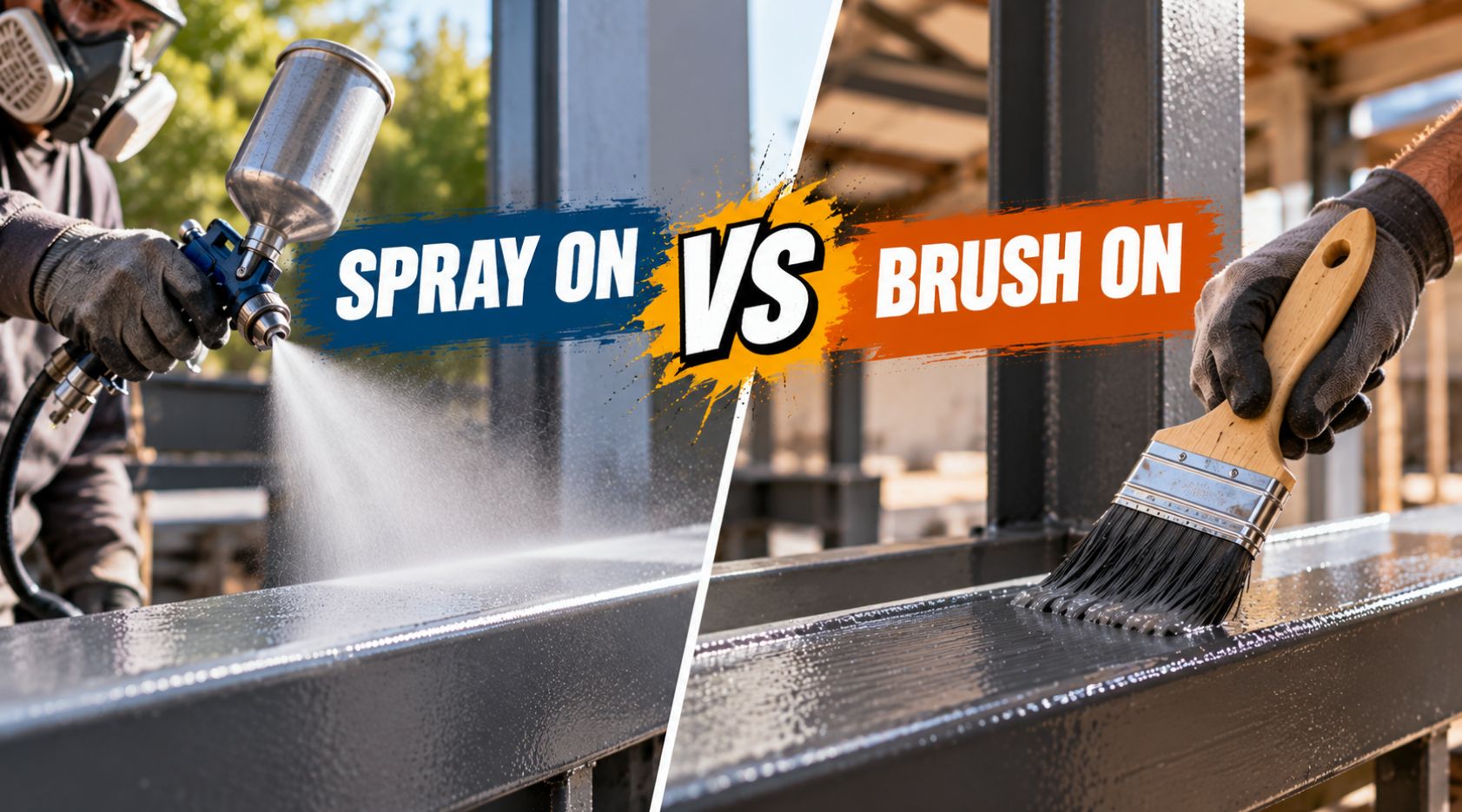
So of course the question comes up. Would spraying have been better? Should you have hired somebody with a rig? That’s really what people are asking when they search spray on vs brush on coating. They don’t care about the chemistry of atomization. They want to know where to put their money and their weekend so the finish doesn’t quit on them in two years.
We’ll be straight with you, because the honest answer isn’t a clean “spray wins.” It’s a bit messier, and a lot more useful.
The Thing Nobody Wants to Hear First
Before we pick a side, a confession. The tool in your hand is not the main reason coatings fail.
Most of the time it’s the surface. Rust that wasn’t fully removed. A film of oil from somebody’s hands. A little moisture trapped in concrete. Old paint that looked solid but was already loose underneath. Put a beautiful coat over any of that and it will peel, whether you sprayed it with a thousand dollar rig or dabbed it on with a brush from the hardware store.
We say this up front because it changes how you read everything else. If your prep is lazy, neither method will save you. If your prep is solid, both methods can last for years. The difference between them is real, but it’s smaller than the difference between a clean surface and a dirty one.
Okay. Now let’s get into it.
What Spraying Actually Does
When you spray, the coating gets broken into a fine mist and carried onto the surface. Tiny droplets land, flow together, and settle into one continuous film. No stroke marks, no lap lines, no little ridges where one pass overlapped the last.
If you’ve ever watched a good applicator work, it’s kind of satisfying. The surface goes from dull to even and wet looking in a few passes, and it reaches places you’d swear a brush couldn’t touch, like behind bolts, inside corners, and across rough texture. We go deeper on the mechanics in our post about how spray on coatings protect and enhance surfaces, if you want the full picture of what happens after the coating leaves the gun.
There’s also a whole category of coatings that simply can’t be brushed. Polyurea is the classic example. It’s mixed right at the gun from two components and it cures in seconds or minutes, so by the time you tried to drag a brush through it, it would already be setting up. If a fast curing, tough as nails membrane is what your project needs, spraying isn’t a preference. It’s the only door. Our rundown of the main types of spray on coatings and where each one fits covers the options in plain language.
The catch? Spraying has a learning curve, and it punishes mistakes. Hold the gun too close and you get runs. Move too fast and you get thin, dry spots. Let the wind catch the mist and half your coating ends up on the neighbor’s fence.
And Brushing, the Old Reliable
Brushing has been around forever because it works. You load the brush, you drag, and you press the coating into the surface as you go.
That pressing matters more than people think. On rough, pitted, or slightly porous surfaces, brushing physically works the coating into the little valleys, which helps it grip. It’s also precise in a way spraying isn’t. You can cut a sharp edge, fill a tiny defect, or hit a weld seam on purpose without taping off half the building.
The downside is that brushing is honest about your skill level. Thickness changes from stroke to stroke. Some spots end up fat, some end up thin, and the thin ones are almost always where the finish starts to wear first. It’s also slow. A big surface can swallow a whole weekend, and a second one.
So Which One Lasts Longer?
Here’s our honest take, and we’ll stand behind it.
On a large, smooth, or complicated surface, a well done spray application will usually outlast a brushed one. Mostly because it’s easier to get an even, full thickness film everywhere, including awkward corners.
On a small job or a rough surface, a carefully brushed coating can match it, and sometimes beat it, because you can really work the product in and control exactly where it goes.
And a sloppy job of either kind loses to a careful job of the other. Every time.
If you like seeing it laid out, here’s the short version:
| What matters | Spray on | Brush on |
|---|---|---|
| Large areas | Fast and even | Slow and tiring |
| Appearance | Smooth, seamless | May show brush marks |
| Tight corners and odd shapes | Gets in there | Takes patience |
| Rough or porous surfaces | Good | Often better, since you work it in |
| Small jobs and touch ups | Overkill | Perfect |
| Material waste | Some overspray | Very little |
| Skill needed | A fair bit | Less, but technique still counts |
Thickness: The Quiet Killer
If there’s one number to care about, it’s thickness. Every coating has a recommended film thickness, usually measured in mils, which are thousandths of an inch. Too thin and it wears through early. Too thick and it can sag, crack, or never fully cure.
This is where spraying often earns its reputation. A trained applicator can build thickness evenly, coat after coat, across a whole surface. With a brush, it’s much harder to know what you’ve put down. You can’t see a few mils. You just hope.
If you’re brushing, there’s a simple fix. Read the data sheet, work out how much coating you should be using per square foot, and measure out what you’ve actually used as you go. If you’ve covered a lot more area than the math says you should have, you’ve gone too thin. It’s boring, but it saves a lot of heartache.
Edges, Welds, and Corners: Where Coatings Go to Die
Walk any old steel structure and look at where the rust started. It’s almost never in the middle of a flat panel. It’s at the edges, around the welds, at the bolts and the sharp corners.
That’s because liquid coatings pull away from sharp edges as they dry, leaving a thinner layer exactly where you need more. Welds and rivets have the same problem. So pros often brush a “stripe coat” on those trouble spots first, then spray everything else. It’s the best of both worlds, and honestly it’s the thing we’d recommend most to anyone who isn’t sure which method to pick. Use the brush where precision matters and the sprayer where speed and evenness matter.
When We’d Reach for a Sprayer
For big, open surfaces, the choice is easy. Floors, roofs, tanks, trailers, building exteriors. The time savings alone are huge, and so is the fact that a sprayed film comes out so consistent.
We’d also spray anything with a complicated shape. Machinery, frames, railings with a hundred little bars. Trying to brush those completely is how you end up with missed spots and a sore wrist.
And if appearance matters, say you want a flawless finish without a single stroke mark, spraying is hard to beat. There’s a reason so many people are drawn to brush free coating solutions once they see the difference in person. If you want to understand how much a good sprayed system can add to a surface’s lifespan, our look at the lesser known benefits of spray on coatings is worth a read.
When We’d Grab a Brush
A gate. A handrail. One piece of equipment. A patch where something got scratched. For small jobs, setting up a sprayer, masking everything off, and cleaning the gear afterward can take longer than the painting itself. A brush is just faster and cheaper.
Brushing is also the better pick on windy days or near things you really don’t want covered in mist, like cars, glass, and your neighbor’s freshly washed truck. And on rough, weathered surfaces, working the first coat in with a brush can give you a better bond before anything else goes on top.
What It Costs, in Money and in Patience
People assume spraying is the expensive option, and on a tiny job, it is. The equipment, the masking, the protective gear, the cleanup. That adds up fast if you’re only coating a few square feet.
But on a big surface, the math flips. A brush costs almost nothing, yet your time isn’t free, and a crew that takes three days with brushes might finish in one with a sprayer. There’s also less downtime, which matters a lot if the thing you’re coating has to stay in service.
There’s waste to think about too. Some sprayed material never lands where you want it. Newer HVLP and airless setups waste far less than the old style guns, but a brush will always waste the least. Small area, brush. Large area, spray. In the middle there’s a gray zone where a contractor can help you run the numbers.
A Quick Word on Safety
Spraying throws fine droplets and fumes into the air, so you need real ventilation, the right respirator, eye protection, and in some cases containment. Certain coatings, especially isocyanate based ones, call for proper training and equipment. Don’t wing that.
Brushing makes far less airborne mess, but open cans still release fumes, particularly indoors. Read the safety data sheet for whatever you’re using, and follow local rules for disposal. It’s not exciting, but nobody ever regretted wearing the respirator.
Mistakes We Keep Seeing
A few patterns show up again and again, whatever method people choose.
Rushing prep is number one, and it isn’t close. Applying too thin to stretch a can a little further is a close second. Then there’s coating on a cold, damp, or windy day because “the weekend is the only time I have.” Using the wrong product for the surface is another classic, since not every coating bonds to every material. And then there’s poor technique, like holding the gun too close or overworking a brush stroke until the finish tears.
Finally, a lot of people coat something once and never look at it again. Even a great finish needs the occasional check. Catch a small chip early and it’s a ten minute fix. Ignore it for two winters and you’re redoing the whole thing.
How to Decide in About Two Minutes
If you’re still on the fence, ask yourself a few honest questions.
How big is the area? If it’s big, lean spray. If it’s small, lean brush. How complicated is the shape? Lots of corners and gaps favors spray. Which coating are you using? If it’s polyurea or another fast curing system, spray is your only option. How rough is the surface? Rough or porous often benefits from brushing, at least for a first coat. And how good are you, really? A careful brush job beats a sloppy spray job every day of the week.
If the answer is a mix of those, do both. Brush the welds and edges, spray the rest. It’s what a lot of experienced applicators do, and there’s a good reason for it.
Frequently Asked Questions
Is spray on coating better than brush on coating?
Not automatically. Spray is usually better for large, complex, or high performance projects because it’s fast and gives an even film. Brush is often the smarter pick for small jobs, touch ups, and rough surfaces. The best choice depends on your surface, your product, and your skill.
Which lasts longer, sprayed or brushed coating?
Neither wins on its own. How long a finish lasts depends mostly on surface prep, film thickness, the product itself, and the weather during application. Spray tends to have an edge where even thickness and full coverage are hard to get by hand, but a careful brush job can last just as long.
Does spraying use more coating than brushing?
Usually, yes, since some material is lost as overspray and bounce back. Modern HVLP and airless sprayers waste less than older conventional guns, but brushing still wastes the least.
Can you brush on polyurea?
In general, no. Polyurea is a two component system that cures in seconds or minutes, so it needs specialized spray equipment. Brushable coatings use slower curing chemistry.
Why do brush marks matter for durability?
Brush marks leave the film thicker in some spots and thinner in others. The thin spots wear through first, and once the surface underneath is exposed, moisture and corrosion can start working on it. The right brush and steady technique keep this to a minimum.
Can I use both methods on the same project?
Yes, and many pros do. A common move is brushing a stripe coat over welds, edges, and corners, then spraying the full surface. It improves coverage right where coatings tend to fail first.
Is spraying hard to do yourself?
It can be. Spray equipment takes practice, and mistakes like uneven passes, runs, and dry spray are easy to make. For large jobs or high performance coatings, hiring an experienced applicator is usually the safer call.
Is surface prep different for spray and brush?
No. The surface needs to be clean, dry, sound, and properly profiled for the coating you’re using, no matter how it goes on. Skip that step and either method will fail.
One Last Thought
If you take one thing from all this, let it be that the best coating job is the one you can actually do well. A patient, careful brush job on a small gate beats a rushed spray job every time, and a pro with a rig will out perform a tired weekend painter on a big roof. Be honest about the size of the job, the surface you’re working with, and your own skill, and the right answer usually shows itself.
And whichever way you go, spend the extra hour on prep. Your future self, standing on that railing in the spring, will thank you.